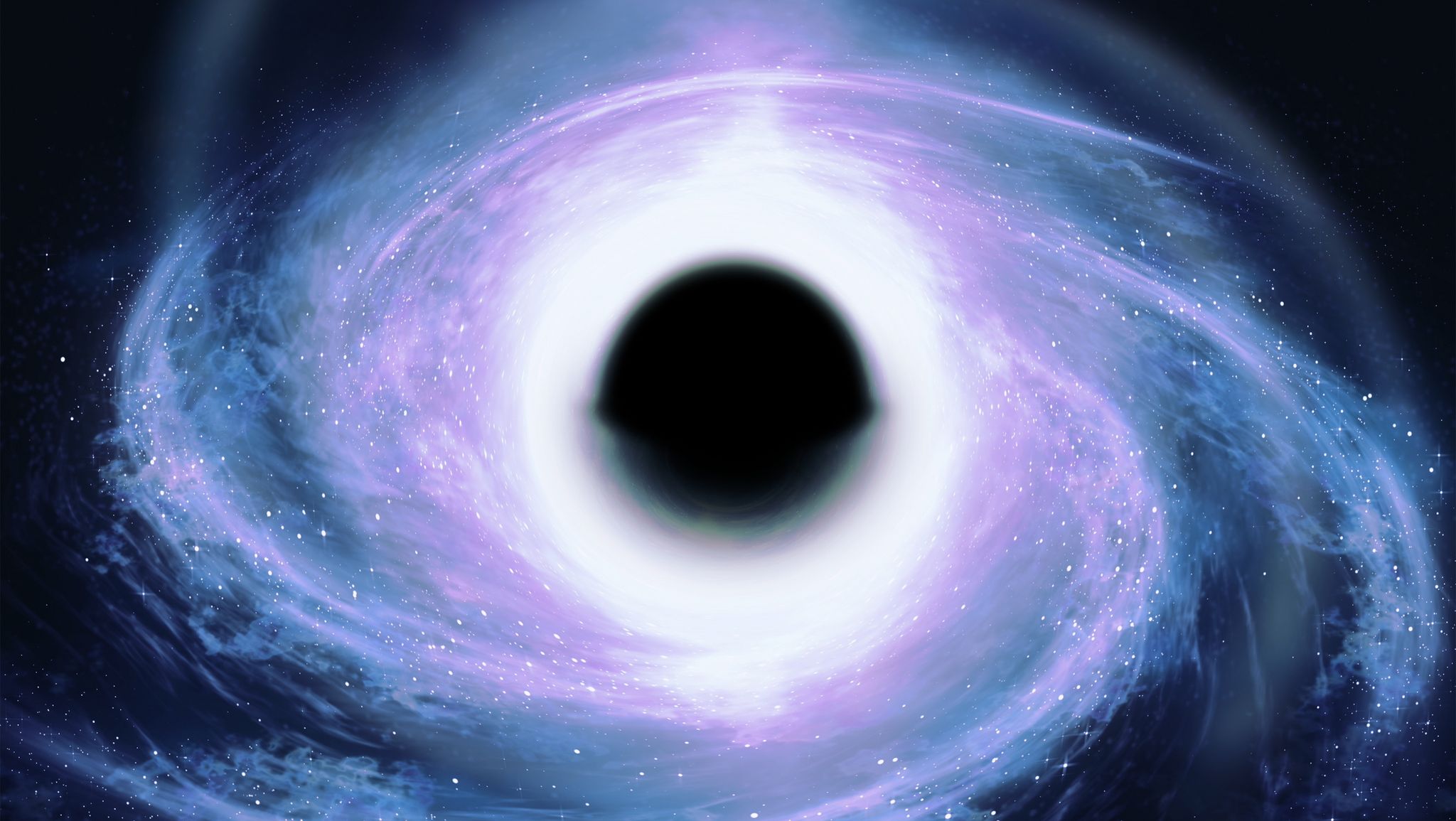
Could white holes be doorways to distant regions of the universe or to other universes entirely, or just endless fountains spraying matter and energy?
Most people are familiar with the concept of a black hole: a “hole” or extreme warping in space and time that endlessly devours any matter unfortunate enough to venture close to it. Even light can’t escape the inexorable gravitational influence of a black hole, meaning these spacetime events are completely dark and can only be seen from their effect on surrounding matter.
The same scientific theory that predicted the existence of black holes also predicts the existence of white holes, the opposite of black holes in almost every respect. Whereas black holes are endless takers of matter and energy, white holes (hypothetically) ceaselessly blast energy out into the universe. And since nothing can escape a black hole, nothing should be able to enter a white hole.
While black holes are tough to spot due to their lack of emissions, white holes should be bright fountains of radiation and, theoretically at least, should be difficult to miss. Yet, so far, astronomers haven’t been able to find any.
But that hasn’t deterred many prominent physicists, such as Italian theoretical physicist and science communicator Carlo Rovelli, from positing their existence. This shouldn’t be too surprising. After all, general relativity has a good track record of theoretically predicting aspects of the universe well before they are discovered including black holes, gravitational waves, and the deviation of light known as gravitational lensing (which is used by instruments like the James Webb Space Telescope to see objects in the early universe).
Yet, white holes stubbornly remain the unfulfilled prediction of general relativity.
How the theory of general relativity predicts white holes
You can’t get into white holes—if you’ll excuse the pun—without first thinking about Albert Einstein’s magnum opus theory of gravity, general relativity.
General relativity was first introduced to the physics community in 1915 as Einstein’s geometric theory of gravity, and it caused quite a stir. Up until then, the best description of gravity was that by Isaac Newton, which still works just fine on small scales but always had considerable failings when it came to explaining physics on massive scales.
The major difference between Einstein’s formulation of gravity and that of Newton was whereas the latter saw space and time as the stages upon which the events of the universe played out, general relativity posited that the united four-dimensional entity of “spacetime” is an active player in this cosmic production.